SIDEBAR
»
S
I
D
E
B
A
R
«
Are you riding on Google Map's back?
Apr 24th, 2008 by Tom Johnson

Nathan, at FlowingData.com, passed along this interesting posting from the guys at Everyblock We think it hints at an interesting point of maturity in the evolution of JAGIS (i.e. Jounalism and GIS). That is, publications will want to start differentiating themselves from online and print competitors by design and look-and-feel attributes. That means NO just using Google Map mash-ups.

Rolling Out Your Own Online Maps and Graphs with HTML/CSS

Wilson Miner and Paul Smith, two co-founders of Everyblock, post tutorials and a little bit of their own experiences rolling out their own maps and creating graphs with web standards.

Why Not Go With Google Maps?

Paul gets into the mechanics of how you can use your own maps discussing the map stack – browser UI, tile cache, map server, and finally, the data. My favorite part though was his reasons for going with their own maps:

Ask yourself this question: why would you, as a website developer who controls all aspects of your site, from typography to layout, to color palette to photography, to UI functionality, allow a big, alien blob to be plopped down in the middle of your otherwise meticulously designed application? Think about it. You accept whatever colors, fonts, and map layers Google chooses for their map tiles. Sure, you try to rein it back in with custom markers and overlays, but at the root, the core component—the map itself—is out of your hands.

Because it's so easy to put in Google Maps instead of make your own (although it is getting a little easier), everything starts to look and feel the same and we get stuck in this Google Maps-confined interaction funk. Don't get me wrong. Google Maps does have its uses and it is a great application. I look up directions with it all the time, but we should also keep in mind that there's more to mapping than bubble markers all in the color of the Google flag.

Remember: a little bit of design goes a long way.

Data Visualization with Web Standards

Wilson provides a tutorial for horizontal bar charts and sparklines with nothing but HTML and CSS. Why would you want to do this when you could use some fancy graphing API? Using Everyblock as an example, data visualization can serve as part of a navigation system as opposed to a standalone graphic:
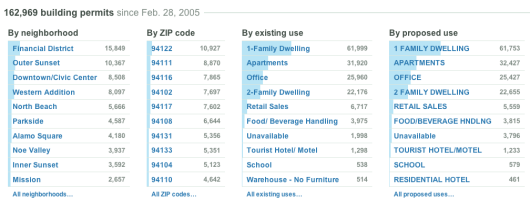

Everyblock Graphs

Sometimes the visualization isn't at the center of attention.

Make sure you check out Everyblock, a site that is all about the data in your very own neighborhood, to see these maps and graphs in action.


Do those maps really matter?
Apr 23rd, 2008 by Tom Johnson

An interesting blurb today in Directions Magazine. It had asked readers:

Final results of the current poll (85 respondents) show that even mapophiles prefer a text front page for news. The poll asked, “How often do you use mapping interfaces to the news, such as Google Earth's new layer of New York Times stories or MetaCarta's GeoSearch News?” 

Significance?  We're not sure, but it might help comprehension if there were more thumbnail maps “printed” with many stories.


And H. G. Wells wrote…..
Apr 11th, 2008 by Tom Johnson

Nathan at FlowingData sends this along….

H. G. Wells on Quantitative Thinking

Posted: 11 Apr 2008 03:32 AM CDT

H. G. WellsThe time may not be very remote when it will be understood that for complete initiation as an efficient citizen of one of the new great complex world wide states that are now developing, it is as necessary to be able to compute, to think in averages and maxima and minima, as it is now to be able to read and write.

H.G. Wells, Mankind in the Making, 1904


UC Berkeley Library's Congressional Research Tutorials
Apr 4th, 2008 by Tom Johnson

We have long been fans — and users — of the research tutorials created by the good folks in the UC Berkeley library.  This item below from The Scout Report reminds me of that work and why I like it so much.  You, too, might find it a helpful link for your training efforts.


UC Berkeley Library's Congressional Research Tutorials [Macromedia Flash Player]

http://sunsite3.berkeley.edu/wikis/congresearch/

Making a clear and direct path through the vast amount of Congressional materials can be quite a chore, even for the most seasoned and experienced researcher. Fortunately, the University of California at Berkeley Library has created these fine Congressional tutorials. Designed to help users locate materials both online and in the library, these tutorials are in the form of short Flash-enabled videos. Most of the tutorials last about two minutes, and they include “Find a Bill”, “How Do I Contact My Representative?”, “Find Congressional Debate”, and “Find a Hearing”. After viewing one (or more) of these tutorials, users can also make their way to the “What's going on in Congress right now?” area to stay on top of the various activities of this important legislative body. [KMG]


The Internet, Data and Phil Meyer
Apr 3rd, 2008 by Tom Johnson

Last week we had the opportunity to participate in a symposium honoring Phil Meyer, Knight Chair of Journalism at the University of North Carolina-Chapel. About 30 journalism educators, practitioners and former students of Phil's spent the better part of two days kicking hard on the topic “”Raising the Ante: The Internet's Impact on Journalism Education and Existing Theories of Mass Communication.”

Kathleen Frankovic, director of surveys for CBS News, used the symposium as the basis for her column last week at cbsnews.com. The column (not quite a blog) is called “Poll Positions” (about public opinion, polls and the process of conducting and reporting them). Here is her column's link: http://www.cbsnews.com/stories/2008/04/02/opinion/pollpositions/main3988828.shtml

Kathy's column makes reference to something we wrote on the topic of the future of polling. That short paper, but with all of its hyperlinks, can be found at “Are We Researching How To Do Research?”

On Thursday night Phil gave a short speech at a dinner attended by the participants and his family. In “Something strange and possibly dangerous,” he highlighted that change is not coming, it is here, and that all of us have to change out thinking and practices if democracy is to survive.

“We need to turn our conversation toward an economic theory of journalism. We need to apply existing theory to understanding the processes and effects of the new media. We need to learn how to sell enlightened understanding to the public so that it can preserve its democratic values. The synergy of mass media and mass production is gone, probably forever. Something strange – and possibly dangerous — is taking its place.”


Strange and dangerous and something most exciting.

»  Substance:WordPress   »  Style:Ahren Ahimsa