SIDEBAR
»
S
I
D
E
B
A
R
«
More insights into how and why journos can't deal with data
Sep 30th, 2009 by analyticjournalism

This tip comes from our friend Stephan Russ-Mohl, of the European Journalism Observatory.

Darned Statistics PDF Print E-mail
by Stephan Russ-Mohl   

European Journalism Observatory, September 26, 2009

 Many journalists face difficulties in dealing with statistics, and frequently lack the competence to present quantitative information to their publics in easy-to-grasp language.

This is nothing new, as most journalism textbooks contain tips on how to deal adequately with numbers and percentages. Thus far, these remain rules of thumb. Three U.S. researchers – Coy Callison, Rhonda Gibson and Dolf Zillmann – recently tested these rules. Drawing from 240 students who participated in an experiment, their empirical analysis provides new, surprising insights.

The test subjects could deal as easily with percentages as with absolute numbers. Contrary to textbooks, they experienced more difficulties when percentages were characterized verbally. For example, “30 percent of the citizens of XY have AIDS” has a meaning different from “3000 of the citizens of XY have AIDS” – but the percentage is no more difficult to grasp and remember. If, instead, the percentage is transformed into the phrase “Three of ten of the citizens of XY have AIDS,” an additional barrier of comprehension is created. The researchers mention, however, that their experiments should be expanded, and that less educated groups still need to be included.

Coy Callison et al.: How to Report Quantitative Information in News Stories, Newspaper Research Journal, Vol 30/Nr. 2, Spring 2009, 43-55.


Wondering what the prez is doing???
Sep 19th, 2009 by analyticjournalism

 We don't know how long this one's been around, but kudos to the gang at the WashPost for taking a concept/tool somewhat on the margin and putting it to good use for both reporters and readers. See http://projects.washingtonpost.com/potus-tracker/

Jobs by SimplyHired

Every day President Obama meets with key members of his administration, Congress, foreign dignitaries, interest groups and regular citizens. Use our interactive database to track how Obama is spending his time, what issues are getting the most attention and who is influencing the debate. 

Subscribe to daily schedule via RSS.

CREDIT: Nathaniel Vaughn Kelso, Madonna Lebling, Karen Yourish, Ryan O'Neil, Wilson Andrews, Jacqueline Kazil, Todd Lindeman, Lucy Shackelford, Paul Volpe
Have information we could use or suggestions about how to improve the site? Contact Us.

© 2009 The Washington Post Company

Vintage Infographics From the 1930s
Sep 11th, 2009 by analyticjournalism

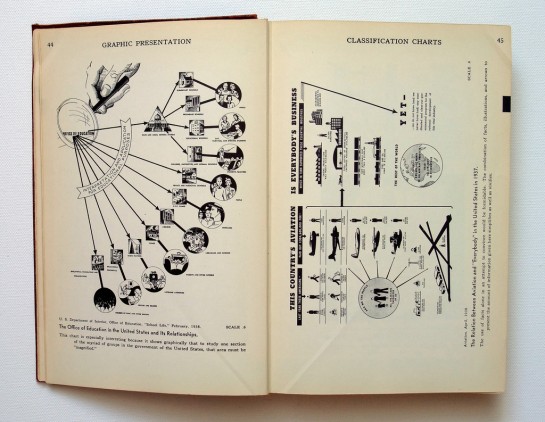
Nathan, over at FlowingData, has posted a fine example of infographics.  The work of Willard C. Brinton is a nice extension of what was being done by U.S. government agencies.  Turns out, Brinton's book can be found in used book sites, and at an affordable price.

Vintage Infographics From the 1930s

Posted by Nathan / Sep 11, 2009 to Infographics / 8 comments

Vintage Infographics From the 1930s

Someone needs to get me a paper copy of Willard Cope Brinton's Graphic Presentation (1939), because it is awesome.

Brinton discusses various forms of graphic presentation in the 524-page book and what works and what doesn't. There's also some good stuff in there about how to make your graphs, charts, maps, etc (by hand).

Have we seen these?

The most interesting part is that many of the graphics – despite having no computers in 1939 – look a lot like what we have today. Albeit, they're a little rougher because they're made by hand, but that's just added flavor.

For example, you've got the Sankey diagram above, or a “cosmograph” as Brinton calls it. The instructions read:

One thousand strips of paper are set on edge to represent 100% and are separated into component parts of 100%.

What? You want me to arrange 1,000 strips of paper to make my diagram? Brilliant, I say.

Here are your choropleth maps…
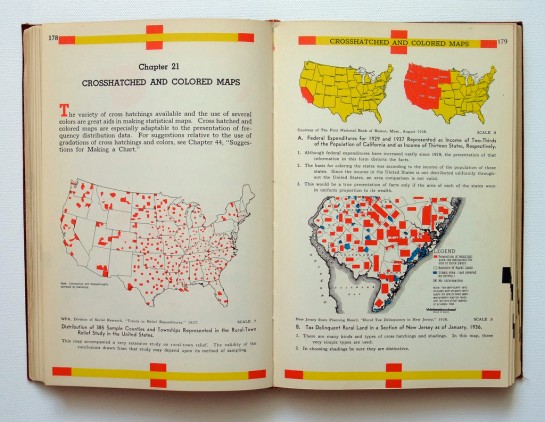
choropleth

network diagram…

network

and of course some of your usual suspects…
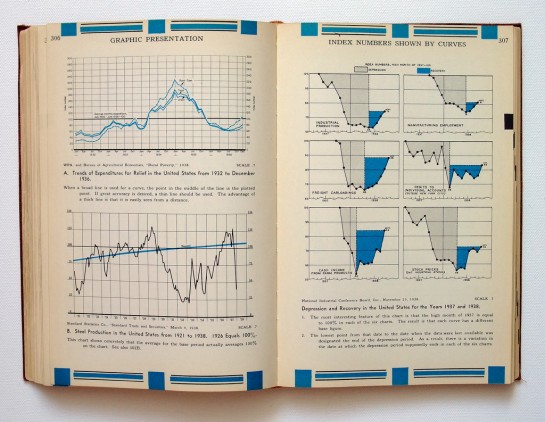
time-series

The entire book is freely available in PDF format, but it's low resolution and takes forever to browse. Michael Stoll has posted some higher quality shots on Flickr.

I still want more though.

Seriously, does anyone know where I can get a copy?

[via Datavisualization.ch]

Like what you see? Subscribe to the FlowingData RSS feed to stay updated on what's new in data visualization.


The Evolution of Darwin's Ideas
Sep 7th, 2009 by analyticjournalism

FlowingData passes along the link to this fine piece of work by Ben Fry.  “Ben Fry Visualizes the Evolution of Darwin’s Ideas” Journos could be using a similar approach to analyze the evolution of the ideas of public officials.

Ben Fry Visualizes the Evolution of Darwin’s Ideas

Posted by Nathan / Sep 7, 2009 to Artistic Visualization / 2 comments

Ben Fry Visualizes the Evolution of Darwin’s Ideas

“Ben Fry, well-known for Processing and plenty of other data goodness, announced his most recent piece, On the Origin of Species: The Preservation of Favoured Traces, made possible by The Complete Work of Charles Darwin Online.

The visualization explores the evolution of Charles Darwin's theory of, uh, evolution. It began as a less-defined 150,000-word text in the first edition and grew and developed to a 190,000-word theory in the sixth edition.

Watch where the updates in the text occur over time. Chunks are removed, chunks are added, and words are changed. Blocks are color-coded by edition. Roll over blocks to see the text underneath.

As usual, excellent work, Mr. Fry.”


»  Substance:WordPress   »  Style:Ahren Ahimsa