SIDEBAR
»
S
I
D
E
B
A
R
«
Race and ethnicity mapped by block
Sep 20th, 2010 by Tom Johnson

Census tract data and maps, while better than nothing, can often deceive because the size of the tract is greatly influenced by population size, not area. It is not uncommon that natural and constructed barriers — mountains or freeways — influence the movements and spatial demographics of a tract. Ah, but BLOCK data, now there is some fine, fine-grained data that we can use to extract insights and meaning.
Once again, Flowingdata.com tips us off to a good visualization of population data and the resulting maps.


Race and ethnicity mapped by block

Sep 20, 2010 to Mapping | Post on Twitter

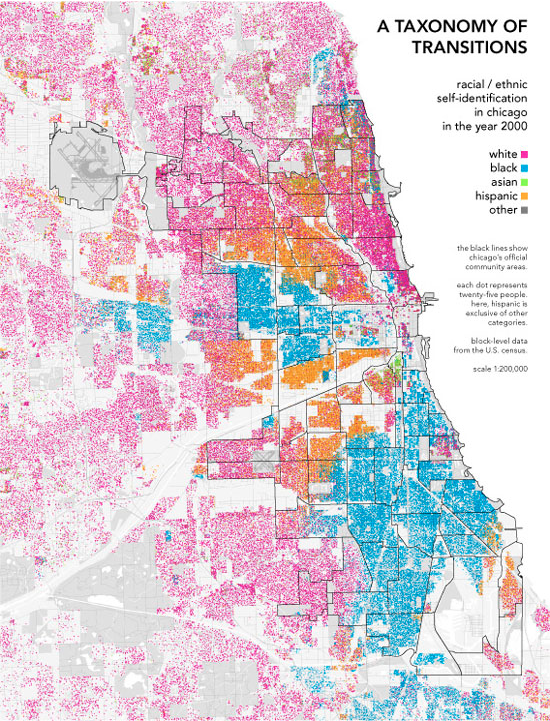
A taxonomy of transitions

Instead of breaking up demographics by defined boundaries, Bill Rankin uses dots to show the more subtle changes across neighborhoods in a map of Chicago using block-specific data US Census.

Any city-dweller knows that most neighborhoods don't have stark boundaries. Yet on maps, neighborhoods are almost always drawn as perfectly bounded areas, miniature territorial states of ethnicity or class. This is especially true for Chicago, where the delimitation of Chicago's official “community areas” in the 1920s was one of the hallmarks of the famous Chicago School of urban sociology.

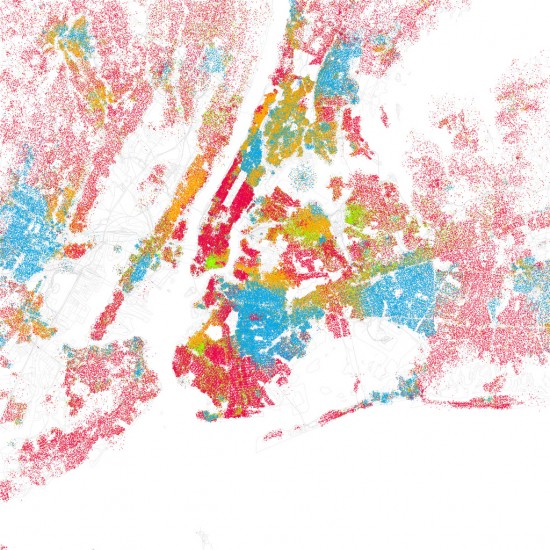
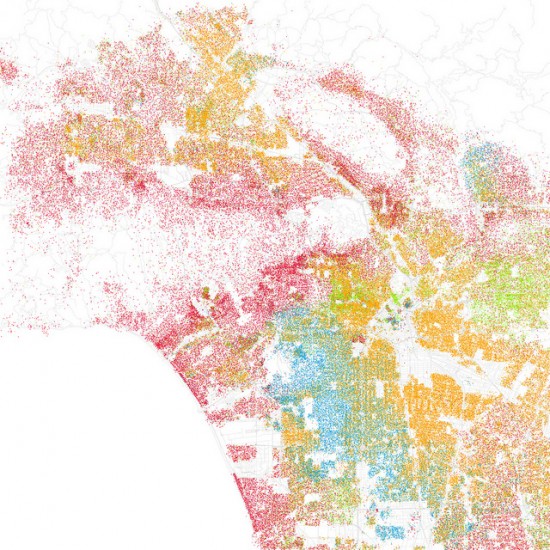
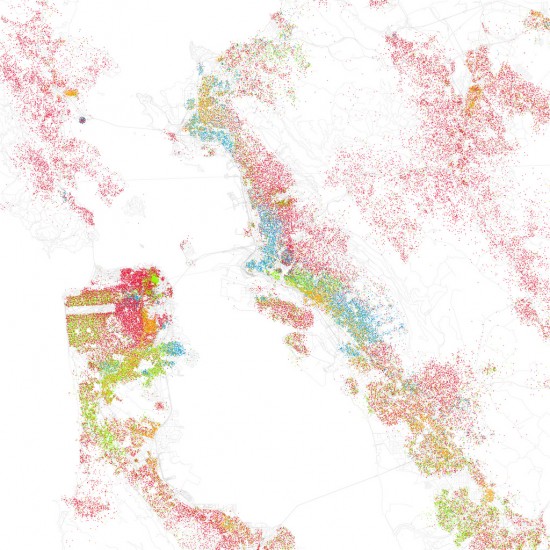
Each dot represents 25 people of the map color's corresponding ethnicity.

Eric Fischer takes the next step and applies the same method to forty major cities. Here are the maps for Los Angeles, San Francisco, and New York, respectively. Same color-coding applies. You definitely see the separation, but zoom and you much more subtle transitions.
[Eric Fischer via Data Pointed]

Taking control of Google Maps
Sep 8th, 2010 by Tom Johnson

Patrick Cain, who correctly describes himself as “a journalist who makes maps for the Web,” has posted a couple neat sets of tips to his blog. Basically, they suggest ways to tweak some of Google's code to improve presentation. Check out his blog tips at

  • http://www.patrickcain.ca/?p=230
  • http://www.patrickcain.ca/

Simplifying map display

I’ve never been a fan of the way Google Maps handles local labels (neighbourhoods, for example) – they are often redundant, inconsistent and wrong, as well as cluttering the map visually.

These examples didn’t take long to collect:

Leslieville is so nice they labeled it twice:

Same with the Bridle Path, more or less:

Google has solved the unresolvable Beach vs. Beaches debate by using both labels:

Forest Hill South is not an ambition of well-off Annexites, but is actually north of Forest Hill:

Ramping up your statistical skills
Sep 3rd, 2010 by Tom Johnson

From FlowingData….

Statistical literacy guides for the basics

Sep 3, 2010 to Statistics | Post on Twitter

Guide to statistical charts - before and after

“You can get pretty far with data graphics with just limited statistical knowledge, but if you want to take your skills, resume, and portfolio to the next level, you should learn standard data practices. Of all places, UK Parliament has some short and free guides to help you with basic statistical concepts. They provide 13 notes, each only two or three pages long that can help you with stuff like how to adjust for inflation, confidence intervals and statistical significance, or basic graph suggestions [pdf]. I like.”


»  Substance:WordPress   »  Style:Ahren Ahimsa